
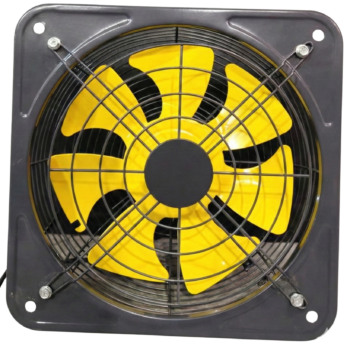
BLDC technology
BLDC (Brushless Direct Current) technology is a solution based on an electronically controlled brushless DC motor. Unlike traditional brush motors, it does not use a mechanical commutator or brushes, which in classic designs are responsible for switching the current in the windings. In a BLDC motor, this function is taken over by an electronic system that precisely controls the power supply to the stator coils. The rotor is equipped with permanent magnets, and rotation is generated by the interaction of the magnetic field generated by the windings. The elimination of friction elements significantly increases the durability and reliability of the entire system.
The principle of operation of a BLDC motor is based on electronic commutation, i.e. sequential switching of the phase power supply depending on the current position of the rotor. Information about its position can be obtained from Hall sensors or determined without sensors based on the analysis of electrical parameters. The controller ensures smooth speed control and stable torque over a wide operating range. This makes it possible to precisely adjust the parameters to the current needs of the ventilation system.
Photosynthesis and air movement
Plants interact with their microclimate, simultaneously responding to and influencing it. A key element in this interaction is the leaf boundary layer: a stagnant air layer enveloping the leaf, creating a resistance to heat and gas exchange. Its thickness, altered mainly by airflow and leaf morphology, determines the leaf-to-air interaction. Field crops experience wind speeds of 0–8 m/s at the canopy top, with wind gusts up to 20 m/s, but wind speeds drop significantly within the canopy, creating localized low-airflow conditions. Conversely, indoor-grown crops always encounter low wind speeds (0–1 m/s) and these, especially with larger leaves, restrict heat and gas exchange, impacting photosynthesis and transpiration. Although the effect of the leaf boundary layer on plant exchange processes has been defined, its magnitude remains poorly characterized and is frequently underestimated.
Model predictions and literature data demonstrate that low boundary layer results in a complex interplay with a large impact on leaf microclimate and limitation of photosynthesis of up to 23%, which depends on stomatal sensitivity to the microclimate, photosynthetic capacity, and the temperature response.